
Building a Responsive HVAC Packaging Supply Chain
- Insights
- Austria, Bahrain, Bulgaria, Denmark, Germany, Hungary, Kuwait, Moldova, Oman, Poland, Romania, Saudi Arabia, South Africa, United Arab Emirates
- Heating & Ventilation (HVAC)
- Industry solutions
Every HVAC manufacturer and distributor has a visible supply chain: the movement of equipment from production to installation. What is often less visible — but equally consequential — is the packaging supply chain that makes that movement possible.
Pallets. Crates. Collars. Boxes. Protective materials. These are not exciting products. They do not appear in product catalogues or specification sheets. But when they are unavailable, inadequate, or inconsistent, the visible supply chain stops moving.
Packaging supply chain failures are disproportionately disruptive. A pallet shortage at peak season can ground shipments regardless of how smoothly the rest of the operation is running. A packaging quality failure can generate product damage claims that far exceed the cost of better packaging. A supplier who cannot scale during demand peaks forces the client to manage the gap with expensive workarounds.
Building a packaging supply chain that is responsive, consistent, and scalable is not a secondary operational concern. It is a primary one.
What Responsive Looks Like in Practice
The defining characteristic of a responsive packaging supply chain is the ability to adjust without disrupting the broader operation. Volume increases during peak seasons. Product line changes that require new packaging formats. Regulatory changes that affect timber certification requirements or label specifications. Logistics network shifts that change transit conditions.
A packaging supplier that can absorb these changes without requiring the client to manage them is not a commodity vendor. It is an operational asset.
Responsiveness is built on several foundations. First, production capacity that is not perpetually at maximum utilisation — leaving room to absorb demand spikes. Second, flexible manufacturing infrastructure that can accommodate specification changes without long retooling cycles. Third, inventory management practices that buffer against raw material variability. Fourth, communication systems that surface problems early, before they become shipment delays.
None of these are visible in a price quote. They become visible when circumstances change, and a supplier either adapts or doesn’t.
The Case for Supplier Investment in Your Business
The most durable packaging supply relationships share a common characteristic: the supplier has made a visible investment in the client’s specific requirements.
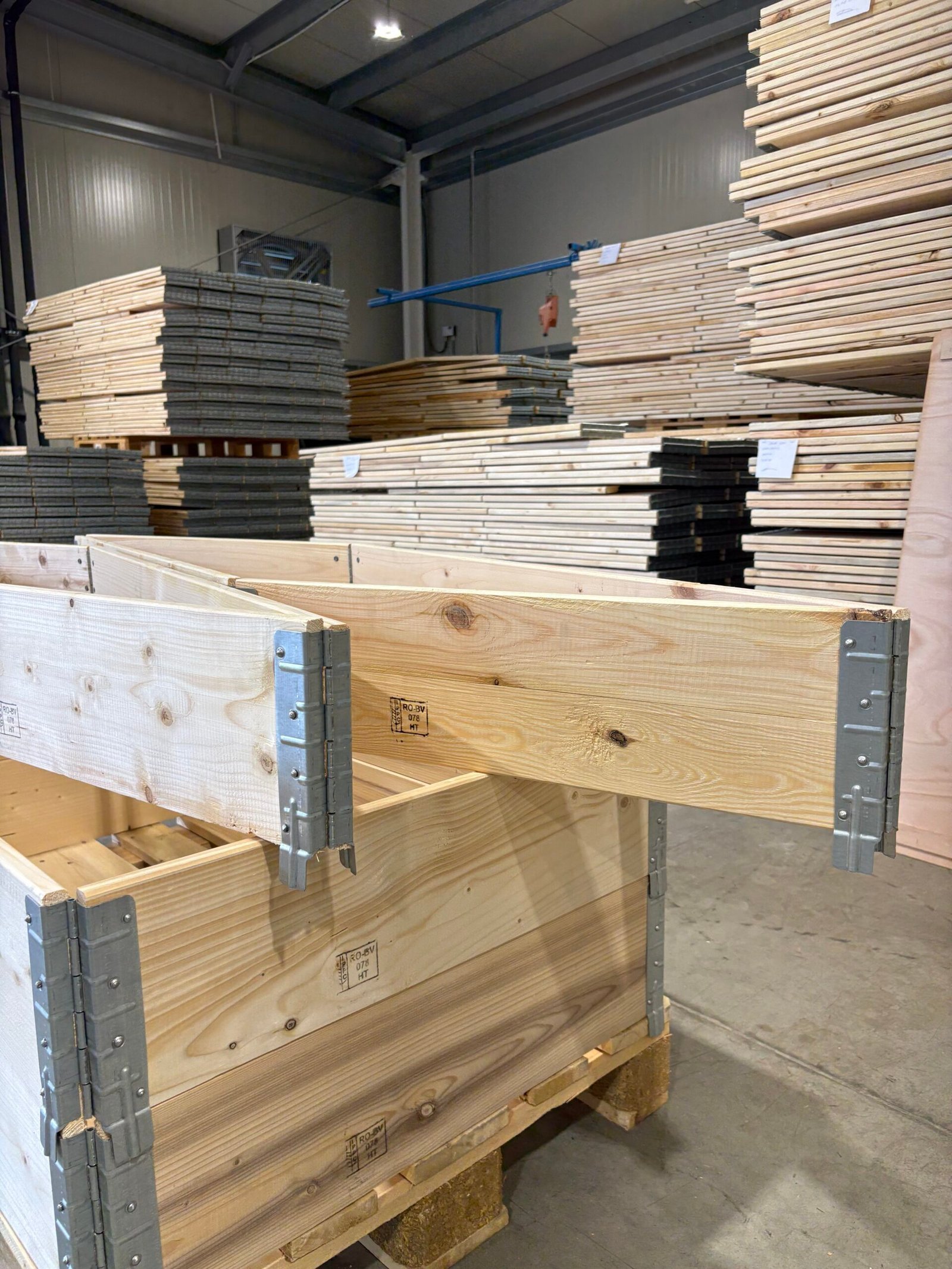
A practical example: when an HVAC client operating with kit solutions in Romania — collapsible pallet collars, pallets, and lids in atypical dimensions — needed to scale volume while reducing lead times, the gap between what standard production could deliver and what the client required became a strategic decision point.
Our response was a new dedicated assembly line, specifically configured to handle the atypical collar and lid dimensions at the throughput the client needed.
This matters for two reasons. First, it solved the immediate problem: lead times shortened, volume capacity increased, and the client’s own production schedule stopped being constrained by packaging availability. Second, it changed the nature of the relationship itself. A supplier who has committed capital to your specifications is not a vendor you manage at arm’s length. They have made a bet on your business. That bet creates alignment — a shared interest in making the supply relationship perform over time.
For HVAC manufacturers and distributors evaluating packaging partners, the willingness to invest is a reliable signal of genuine capability. Suppliers who quote quickly and deliver on standard formats are plentiful. Suppliers who commit to understanding and solving your specific challenges are considerably rarer.
When the Detail Is Everything
Responsiveness is not only about volume and speed. It is also about technical depth — the ability to solve problems that standard supply chains are not designed to handle.
Take a look at the recent case with a company from the energy sector: they required specialized pallets for their expansion vessels.
A straightforward task on paper. In practice, the drilling position must be calculated to avoid compromising the structural members of the pallet itself. Place the fixing point in the wrong location, and the pallet deforms under load. The product shifts.
A responsive packaging partner does not guess at this. We run a process: client specifications are gathered, samples are produced, and those samples are brought to the client’s facility and tested against real handling equipment and real workflows.
Not every client arrives with complete technical documentation — and a capable partner does not require it. They close the gap through direct field observation, iterative refinement, and the kind of on-site collaboration that no catalogue can replicate.
This takes longer than placing a standard order. The result is a pallet specification that holds under actual operating conditions — optimized for both structural safety and cost-efficiency. That combination is what separates a supply chain that responds to problems from one that prevents them.
Build a Packaging Supply Chain That Performs
Whether your challenge is reliability, non-standard specifications, export compliance, or supply chain scale, there is a structured path to a packaging operation that supports rather than constrains your business.
Related publication

PPWR: what it means for your packaging supply chain
September 3, 2026
- Insights
- Austria, Bulgaria, Denmark, Germany, Hungary, Poland, Romania
- Business, Industry solutions, Sustainability
From Order to Airlift in 48 Hours: ISPM 15 Certified Wooden Pallet Collars for Military Defence Logistics
August 27, 2026
- Insights
- Austria, Bahrain, Bulgaria, Denmark, Germany, Hungary, Kuwait, Moldova, Oman, Poland, Romania, Saudi Arabia, South Africa, United Arab Emirates
- Defence
- Industry solutions
Would you like to know more details?
Fill in the form or ask the chatbot to establish the contact with us



 Bulgarian
 English
 Germany
 Hungary
 Poland
 Romania