
PalletBiz Publishes Its Annual Sustainability Report 2025
- Insights, Press Releases
- Austria, Bahrain, Bulgaria, Denmark, Germany, Hungary, Kuwait, Moldova, Oman, Poland, Romania, Saudi Arabia, South Africa, United Arab Emirates
- Group news, Sustainability
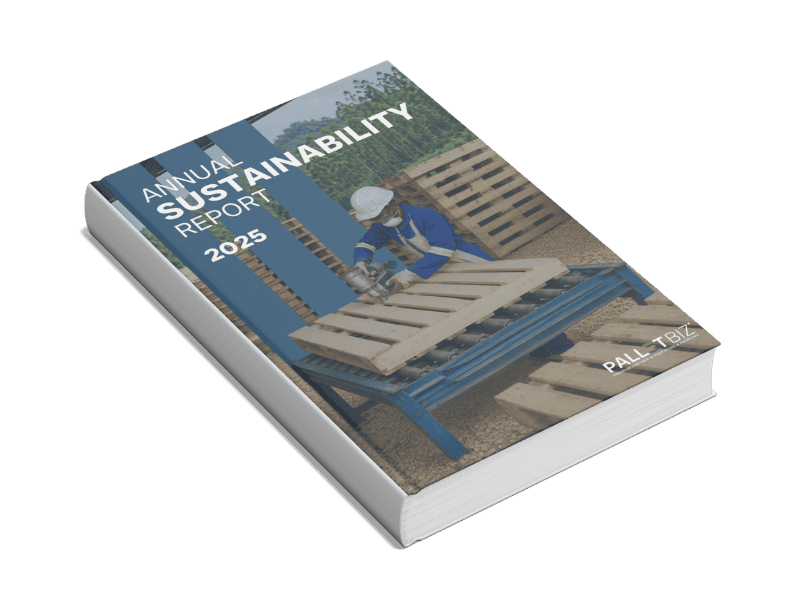
We are pleased to share the PalletBiz Annual Sustainability Report 2025, now in its third edition. This year’s report reflects a challenging market environment for our industry, and we report our progress transparently: strong gains in circular product sales, certified wood sourcing, and waste recovery; a first network-wide carbon estimate; alongside an open account of where we fell short on workforce retention.
A voluntary reporting
No regulation requires a company of PalletBiz’s size to measure, verify, and disclose its sustainability performance. Reporting mandates such as the CSRD are designed primarily for large, listed corporations, a category that does not apply to PalletBiz’s franchise network. Yet for the third year running, we have chosen to report anyway, because we believe accountability should not depend on obligation.
PalletBiz caters to both Euro and non-Euro pallet needs, with all pallets heat-treated according to IPPC ISPM-15 standards. Additionally, PalletBiz offers metal packaging solutions for delicate or heavy items.
What the report covers
The 2025 report consolidates data across PalletBiz’s full network — 13 entities spanning Europe, the Middle East, and Africa, from Romania and Germany to Saudi Arabia, Bahrain, and South Africa. Each entity’s contribution is weighted by size, and results are presented across three consecutive reporting periods (FY2024, H1 FY2025, and FY2025) with year-on-year comparison, so that performance is tracked consistently.
The KPI framework itself is organised around environmental, social, and governance indicators — from circular product sales and wood sourcing to supplier standards and workforce data, reflecting the three pillars highlighted in our Sustainability strategy.
Progress against target
- Circular product sales: revenue share of 3R (repaired, reused, recycled) products rose to 18.4% of network revenue, comfortably exceeding the 10% target.
- Sustainably sourced wood reached 53.0% of raw material across the network, exceeding the 50% target.
- Packaging waste recovered held at 91.9%, well above the 60% target.
- For the first time, PalletBiz produced a network-wide carbon estimate, recording a partial-basis product footprint of approximately 6,245 tCO₂e across reporting entities — a baseline for future reduction efforts.
- Suppliers signed up to PalletBiz’s Code of Conduct rose from 41.4% to 90.3%, well ahead of the 70% target.
- Sites with repair or recycling capability grew from 7 to 10 across the network, in line with the target of one additional site per year.
Not every metric moved in the desired direction. Production labour retention declined to 77.9%, against an 85% target, a signal that workforce stability remains an area requiring continued attention in a demanding market year.
The report does not obscure this: publishing the KPI framework as designed, including results that fell short, is part of what voluntary disclosure means at PalletBiz.
Why report at this scale
Sustainability, properly implemented, is not a cost existing in isolation from the business — it is a driver of it. Circular products, certified wood sourcing, and expanded repair capability are the same practices that sustain PalletBiz’s competitiveness, its access to sustainability-linked financing, and the confidence of clients who increasingly scrutinise the sustainability credentials of their own supply chains. External accountability of this nature remains uncommon among SMEs in our industry — an area where we believe the sector should progress, and where we would rather lead by example than wait to be asked.
Related publication
Packaging Irregular Aerostructures for Military Transport Aircraft: A Custom Wooden Crating Case Study
September 23, 2026
- Insights
- Austria, Bahrain, Bulgaria, Denmark, Germany, Hungary, Kuwait, Moldova, Oman, Poland, Romania, Saudi Arabia, South Africa, United Arab Emirates
- Defence
- Industry solutions

PPWR: what it means for your packaging supply chain
September 3, 2026
- Insights
- Austria, Bulgaria, Denmark, Germany, Hungary, Poland, Romania
- Business, Industry solutions, Sustainability
Would you like to know more details?
Fill in the form or ask the chatbot to establish the contact with us



 English
 Germany
 Hungary
 Poland
 Romania