
Custom Wooden Boxes for High-Value HVAC Equipment Export
- Insights
- Austria, Bahrain, Bulgaria, Denmark, Germany, Hungary, Kuwait, Moldova, Oman, Poland, Romania, Saudi Arabia, South Africa, United Arab Emirates
- Heating & Ventilation (HVAC)
- Industry solutions, Wooden packaging
When HVAC equipment crosses borders, the packaging it travels in becomes the last line of defence between manufacturing investment and customer satisfaction. Compressors, heat exchangers, control cabinets, and assembled HVAC units are high-value products. Their physical condition on arrival determines whether an export relationship grows or stalls.
Wooden boxes built to generic specifications may pass the paperwork test. But in transit — through port handling, temperature variation, humidity, and multi-modal transfer — the gaps between a generic solution and a purpose-built one become visible. Damaged products. Insurance claims. Delayed commissioning. Lost orders.
The commercial case for custom wooden boxes is, in most markets, straightforward.
What Custom Actually Means
In packaging, the word “custom” can mean a lot of things. In practice, meaningful customisation comes down to one test: was this box designed around the product, or was the product fitted into a box that already existed?
For HVAC equipment, the answer to this question determines everything. The internal dimensions of the box must accommodate the product without excessive void space that allows movement, and without compressing protective materials that need room to absorb impact. The structural members of the box must be positioned to transfer load without stressing the product’s own structural points. The closure system must be accessible during unpacking, without requiring tools that may not be available at the installation site.
These are not abstract requirements. They emerge from real operating conditions, and they can only be addressed by a packaging process that starts with the product’s actual dimensions and works outward.
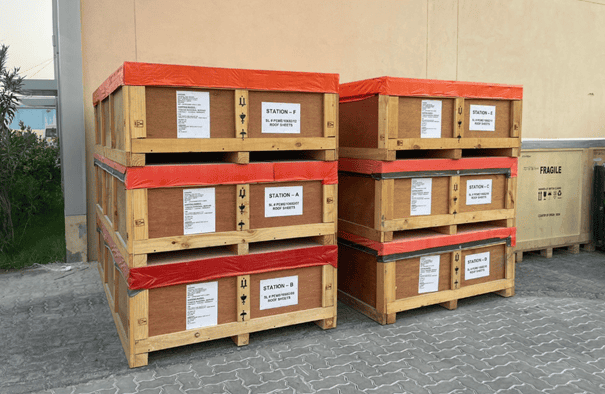
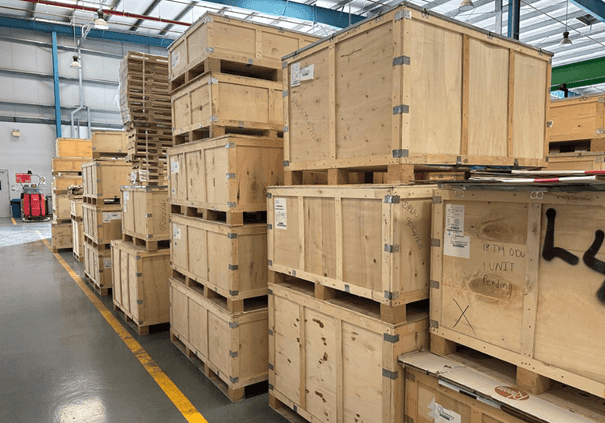
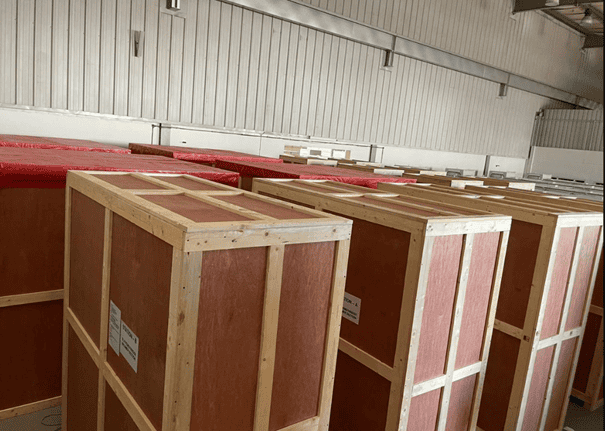
The Role of Technical Specifications in Packaging Quality
Custom wooden box production begins with specifications. When clients provide complete, accurate dimensional and weight data, the development cycle is short. The first sample is close to final. Validation is fast.
In practice, complete documentation is not always available at the start of a project. Clients in fast-moving procurement environments often initiate packaging discussions before final product specifications are locked. This is a common and manageable situation — provided the packaging supplier has the capability to work iteratively, update specifications as product data arrives, and manufacture against a moving target without losing quality control.
The suppliers best positioned to handle this are those with production capacity and technical teams capable of rapid iteration, not those who require complete documentation before any work begins.
Repeat Orders as a Signal of Packaging Performance
In export packaging, repeat orders are the most honest performance metric available.
A client who returns for additional shipments has seen how the box performs under real conditions. They have watched the product arrive intact. They have managed the unpacking process at the installation site. They have fielded feedback from the end customer.
If the packaging failed at any point in this chain, they would not return. The fact that they do — and that order volumes grow over time — reflects genuine operational confidence in the packaging solution.
This is the signal that matters. Not the specification document. Not the sample sign-off. The repeat order, placed without hesitation, for a higher volume than the first.
Long-Term Supply Relationships in Export Packaging
Export packaging for HVAC equipment is not a transactional category. The logistics context is complex enough, and the product values high enough, that clients are not cycling through suppliers in search of marginal price improvements.
What they are looking for is a supplier who understands their product, maintains consistent production quality, and responds reliably when volumes shift. Finding that supplier takes time. Once found, the relationship is worth maintaining — and developing.
From the supplier side, this dynamic creates an obligation as well as an opportunity. The obligation is to maintain production quality across the full lifecycle of the relationship, not just during the initial sampling phase. The opportunity is to grow the relationship as the client’s export volumes expand, adding new products, new markets, and new packaging challenges to an existing, trusted framework.
This is how durable commercial relationships in export packaging are built: not through the lowest quoted price, but through demonstrated performance over time.
Wooden Box Specifications for HVAC Export: Key Considerations
For procurement and logistics teams evaluating wooden box solutions for HVAC equipment, the key parameters include:
Internal dimensions. Must be specified from the product out, with appropriate clearance for protective materials.
Load-bearing capacity. The box must support stacking forces during containerised transport without transmitting those forces to the product.
Moisture resistance. For international shipment, ISPM 15-compliant heat-treated timber is typically required. Additional moisture barriers may be needed for high-humidity routes.
Access and unpacking. Closure design should allow controlled access at the installation site without specialised tools.
Labelling and documentation. Regulatory and carrier labelling requirements vary by destination. The box design must accommodate these without compromising structural integrity.
Start with Your Product Dimensions
The fastest path to a working wooden box solution is a conversation that starts with what you are shipping and where it needs to go. Technical specifications are helpful, but not a prerequisite. If the first step is a discussion of product type, destination market, and handling conditions, that is a productive starting point.
Related publication
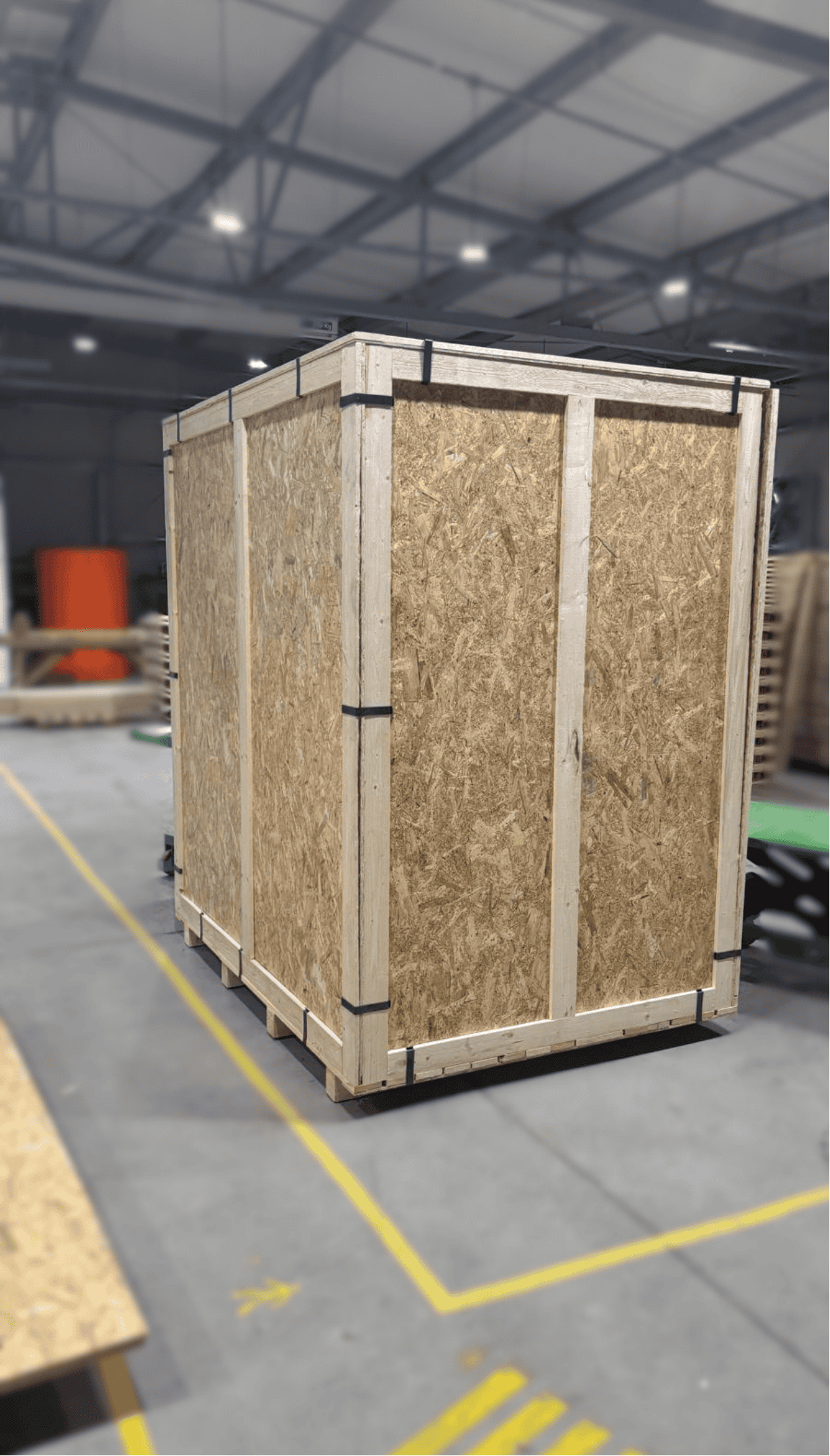
Packaging Irregular Aerostructures for Military Transport Aircraft: A Custom Wooden Crating Case Study
September 23, 2026
- Insights
- Austria, Bahrain, Bulgaria, Denmark, Germany, Hungary, Kuwait, Moldova, Oman, Poland, Romania, Saudi Arabia, South Africa, United Arab Emirates
- Defence
- Industry solutions

PPWR: what it means for your packaging supply chain
September 3, 2026
- Insights
- Austria, Bulgaria, Denmark, Germany, Hungary, Poland, Romania
- Business, Industry solutions, Sustainability
Would you like to know more details?
Fill in the form or ask the chatbot to establish the contact with us



 English
 Germany
 Hungary
 Poland
 Romania